


 Nederland
 Zweden
 Uk
Uk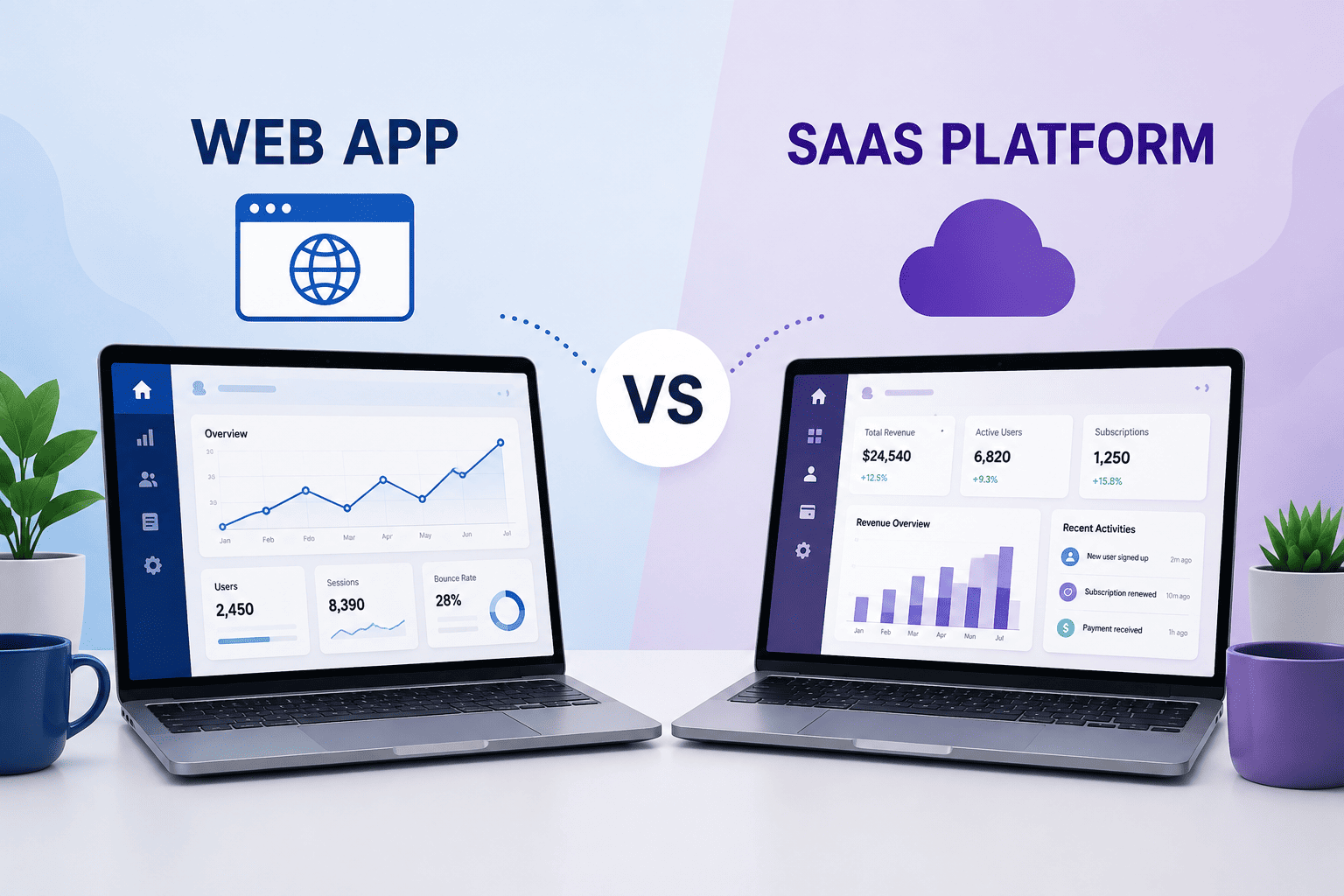
You need software. Do you build something that’s genuinely yours, or subscribe to something someone else already built? It sounds like a simple choice, but it shapes your costs, your flexibility, and how much control you actually have over your own data for years afterward. Companies exploring a web app development usually ask this exact question before they’ve even spoken to a developer, and getting the answer wrong means either paying for flexibility you’ll never use, or maintaining infrastructure you never needed.
This guide breaks down where each option actually wins, so the decision comes down to what fits your business, not which option happened to come up first in a Google search.
What’s the Real Difference Between a Web App and a SaaS Platform?
A web app is software you access through a browser instead of installing on a device, anything from a simple internal tool to a customer-facing platform serving thousands of users. SaaS is a business model layered on top of that: a web app sold as a subscription, one product serving many customers, centrally maintained and updated by the vendor. Salesforce and Slack are SaaS. Every SaaS product is a web app; not every web app is SaaS.
The table below breaks down how that distinction plays out in practice.
| Factor | Custom Web App | SaaS Platform |
| Ownership | Fully owned by your business | Owned and controlled by the vendor |
| Built around | Your specific workflows and processes | A broad, standardised use case |
| Customization | Unlimited — shaped to your exact needs | Limited to what the provider offers |
| Time to launch | Longer — requires a full build | Fast — sign up and start using it |
| Pricing model | Upfront investment, then maintenance | Recurring subscription, usually per user |
| Data control | Data stays on your own infrastructure | Data lives on the vendor’s infrastructure |
| Scalability | Scales with your architecture decisions | Scales with the vendor’s platform limits |
| Updates | Managed on your own timeline | Pushed automatically by the vendor |
| Vendor dependency | None — you control the roadmap | High — features and pricing follow the vendor |
| Best suited for | Unique or differentiating workflows | Standard, common business processes |
When Does It Make Sense to Build a Custom Web App Instead of Buying SaaS?
Custom makes sense the moment your workflow stops fitting neatly into someone else’s product. A common early sign: your team is building spreadsheets around a SaaS tool’s limitations, or exporting data just to reshape it somewhere else.
Go custom when:
- Your processes are specific to your industry or internal structure, and no off-the-shelf platform models them accurately
- You’re paying for features you don’t use, bundled in because the vendor built for a broader market than yours
- Data ownership matters; you don’t want operational data living inside someone else’s infrastructure, under someone else’s terms
- The software itself is meant to become a revenue stream, not just an internal tool
- You want control over the roadmap, instead of waiting on features the vendor decides to prioritise
This is usually the point where businesses start looking into a web app laten maken rather than adding another workaround to an existing tool.
When Should You Stick With a SaaS Platform Instead of Building Custom?
Not every business problem deserves a custom build. If your workflow is common, a mature SaaS product will likely outperform anything built from scratch, at least early on.
Stick with SaaS when:
- Your needs match standard categories like email marketing, basic CRM, accounting, or project tracking
- Speed matters more than a perfect fit; SaaS can be live in days, not months
- You don’t want to manage infrastructure, security patching, or hosting
- You’re still validating whether an idea works, and don’t want to commit to a build yet
- You don’t have the internal team or budget to manage a custom project right now
The catch: “standard” workflows don’t always stay standard. As a company grows, the gap between what the SaaS tool offers and what the business actually needs tends to widen, and that’s usually when the custom conversation resurfaces.
How Do the Long-Term Costs Actually Compare?
A lot of decisions go wrong here, because people compare the SaaS subscription price against a development quote and stop there. That’s not really a fair comparison.
SaaS costs tend to grow over time because of:
- More users being added as the team scales
- Premium features that sit behind higher pricing tiers
- Extra storage or usage limits
- Additional integrations or API access fees
Custom web apps work differently:
- Bigger investment upfront, before anything launches
- Lower recurring cost afterward, mostly maintenance and improvements
- No per-seat licensing that scales against you as you grow
There isn’t a fixed point where one becomes cheaper than the other; it depends on user count, integration complexity, and growth speed. But the general pattern holds: SaaS is usually more economical early on, and custom development tends to become the stronger investment once the business outgrows what a generic platform was built for.
This is exactly the kind of comparison worth running before committing to saas development instead of a straightforward custom build.
Who Owns the Software, the Data, and the Roadmap?
Ownership doesn’t show up on a pricing page, but it’s one of the biggest long-term factors.
With SaaS, you’re a tenant:
- Your data sits inside someone else’s system, governed by their terms
- Leaving later can mean exporting years of records, rebuilding integrations, and retraining staff
- This friction has a name, vendor lock-in, and it’s worth thinking about before signing, not after you’ve outgrown the platform
With a custom web app, you own it outright:
- The code is yours
- The data lives where you decide it should live
- No vendor gatekeeping if you want to change direction or add something nobody else needs
- Easier to satisfy data residency and audit requirements in regulated industries
Can You Start With a Web App and Turn It Into a SaaS Platform Later?
Yes, and it’s a common, sensible path. Two directions this usually goes:
- Custom to SaaS: a business builds a web app to solve its own internal problem, realises other companies have the same pain point, then restructures it into a multi-tenant product with pricing attached. This is where saas development planning becomes necessary: multi-tenancy, billing, and onboarding all need to be designed properly, not bolted on later.
- SaaS to custom: a company starts with an off-the-shelf tool to validate an idea quickly, then commissions custom development once they know exactly what’s missing
Neither path is wrong. What matters is being intentional about which stage you’re in, rather than defaulting to whichever option is easiest to sign up for today.
How Should You Decide Between the Two for Your Business?
A practical rule: buy the commodity, build the differentiator.
If you’re a software company yourself or planning to become one, this decision carries extra weight; your core product usually belongs on the “build” side of that line.
- Standard need, common across your sector (payroll, basic scheduling, generic CRM) → SaaS is probably the smarter spend
- Something that sets you apart from competitors → building it custom protects that advantage instead of handing it to a vendor everyone else can also subscribe to
Before committing either way, ask:
- Does an existing SaaS tool actually cover most of what we need, or are we already planning workarounds?
- Are we comfortable with our operational data living on a third-party platform long-term?
- Do we have the internal appetite to manage a custom build, or would that stretch resources we don’t have?
- Will we still be using this in five years, and does that change the calculation?
There’s rarely a universally right answer. It depends on how standard your workflow really is, how much control matters to you, and how the software fits your bigger growth plans.
Final Takeaway
Zedrox is a software company working across custom software, web applications, and AI-driven tools, helping Dutch businesses map out exactly where an off-the-shelf platform falls short and where a tailored build pays off.
Whether you’re solving an internal problem or bringing a new product to market, getting the direction right early saves time, budget, and a lot of rework down the line.
Frequently Asked Questions
How is SaaS pricing different from traditional web applications?
SaaS subscriptions are monthly or yearly, whereas web apps tend to have higher initial development costs. For Dutch companies, SaaS is typically less expensive to get started with, easier to budget, and more predictable in the long run.
Is it easy to switch from a web app to a SaaS platform?
Yes, but it depends. Moving to an existing SaaS is usually easy, but converting a web app to SaaS requires changes for users, billing, security, and scalability. Data migration and GDPR are big issues in the Netherlands.
Why should small businesses choose a SaaS platform instead of a web app?
SaaS enables small Dutch businesses to launch faster, cut down on IT maintenance, and grow without huge investments. It provides automatic updates, remote access, and predictable pricing, ideal for teams with limited technical skills.
How long does it take to build a custom web application versus deploying a SaaS solution?
A custom web app takes weeks to months, while an existing SaaS can be deployed in days or weeks. Building your own SaaS takes longer because it needs subscription, security, and scaling features.